A note on the human side of advice
Advisor Judgment Is a Wealth Firm's Biggest Asset, and It's Retiring
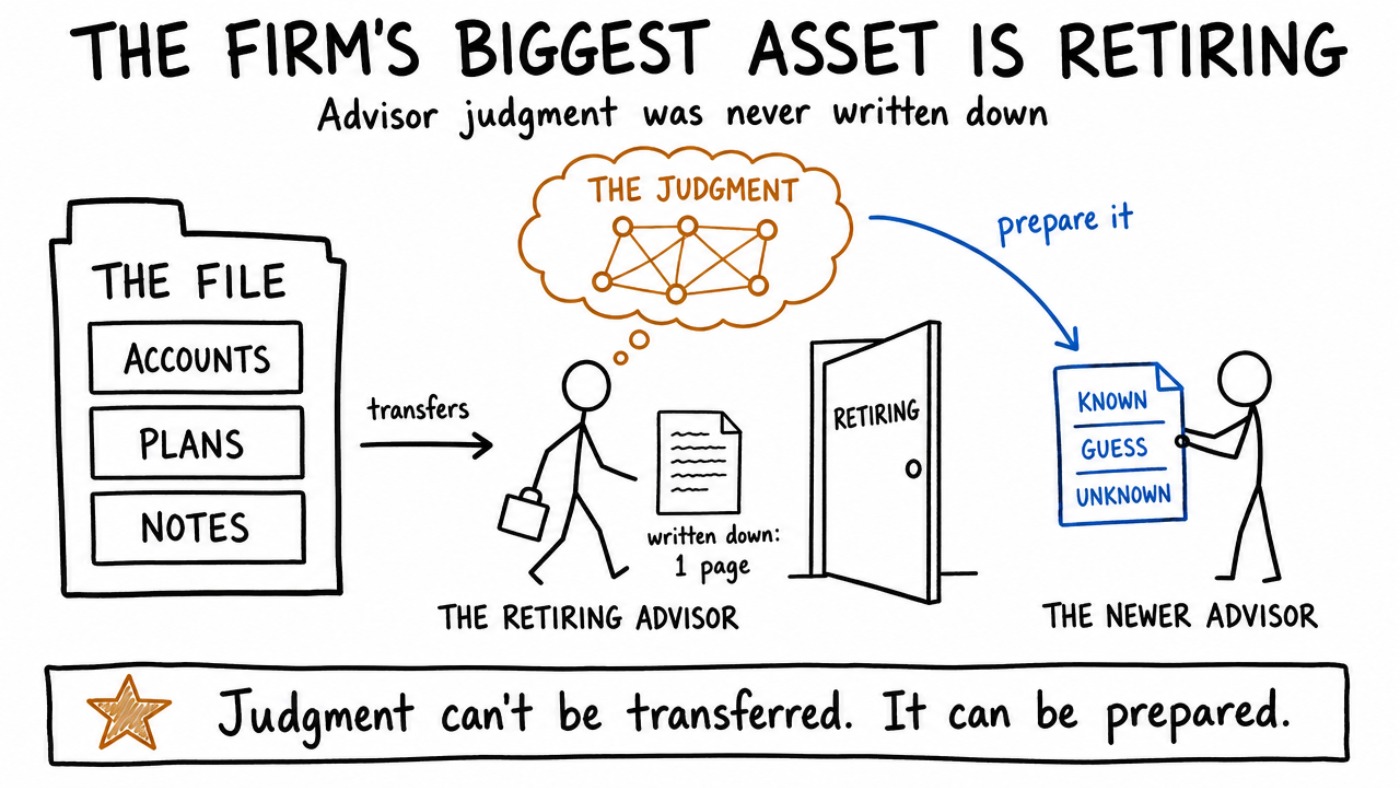
What leaves with the 105,887 advisors retiring this decade
Ask a retiring advisor, in their last week, to write down everything they know about their top twenty households that isn't already in the CRM. Most will fill a page in ten minutes and then stop. Not because they've run out. Because the rest doesn't come as sentences.
That page is what the successor gets, along with the accounts, the plans, the notes from every review, and three months of overlap. What stays with the retiring advisor is the rest: that one household's question about fees is really a question about trust, that the founder who just sold his company isn't ready to see the proceeds move, which spouse actually decides. Twenty years of it, and there was never a form for it.
Cerulli counts 105,887 advisors planning to retire over the next decade, more than a third of the industry, holding 41.4% of its assets. That's usually described as a staffing shortage. Inside a firm it shows up as a continuity problem. Every one of those books goes to someone who has the file and is years away from the judgment that went with it.
And judgment is where a wealth firm grows. A firm grows in the client conversation: the meeting where a household decides whether to consolidate more assets here, whether to refer a friend, whether the spouse and the adult children stay when the money moves. Those conversations go well when the advisor in the room has the judgment.
Three things make this urgent rather than eventual, and they're arriving together. The judgment is retiring. Growth is multiplying the handoffs: every acquisition, merger, custodian referral and reassignment moves clients to advisors who don't know them yet, so firms are growing faster than their knowledge of their own clients can follow. And AI is making everything around the judgment cheap, the plan, the notes, the analysis, the follow-up. When every firm has the same tools, the advisor's read on the person is what's left to compete on.
That's the asset. It was never on the balance sheet, it's leaving, and it has become the difference between firms.
Same file, two advisors, two meetings
Put two advisors in front of the same client, with the same file, and watch what each one does with it.
A client asks about fees. The newer advisor answers the question about fees. Your best advisor answers it too, and then notices something: this client hasn't asked about fees in eleven years, and the advisor who brought them to the firm retired in the spring. So before moving on, they ask how the transition has felt. The fee question turns out to be a trust question.
The business sale has closed, and the plan says the proceeds should be invested now. The math is right, and the newer advisor presents the allocation. Your best advisor presents it too, and asks one question first: what has it been like since the sale closed? The owner talks for ten minutes. He still drives past the building on his way home. Your best advisor suggests they revisit the allocation next quarter. The plan didn't change. The timing did.
A couple nods through the estate review, and the newer advisor moves to signatures. Your best advisor notices that one of them nodded a beat late every time, and asks her directly what she thinks about the plan for the house. She has a different view. It takes twenty minutes, and it saves the family a fight they'd have had after the signing.
Same file, every time. Same CRM, same plan, same notes from the last meeting. What's different is what the advisor does when the file doesn't settle the question, and in every case it was the same move: notice something, hold it as a possibility, and ask. That's advisor judgment.
Experience gives your best advisor two things that make the move possible. The first is a library of patterns, and years of fitting them to clients who are never quite like the last one. A hundred prior conversations tell them a late nod is worth a question. This couple, this house, and the way she looked at him first tell them which question. The second is less obvious and matters more. They know what they don't know yet. They don't decide the fee question is about trust. They hold it as a possibility and ask. A newer advisor, handed the same signal, is more likely to skip the asking and treat the guess as a fact.
Hold onto that second part. It's where the next generation of tools is about to go wrong, and we'll get there. Both of those things come from years in the room, which is the problem, because firms have spent the last decade trying to shorten those years.
Judgment still takes ten years, after all the training
The money has followed. J.P. Morgan has tripled training hours for its private bank advisors since 2019, increased hands-on practice 150%, and added AI role-play. Most firms of any size now run an academy, a coaching program, a mentorship track, or all three. The investment is real, and it works for the things it was built for: the technical knowledge, the planning, the process.
Judgment is the piece it hasn't shortened, for two reasons.
The first is that training teaches scenarios, and a scenario is never quite the client in front of you. Your best advisor has seen a hundred business sales. This owner is also a new grandfather, his wife ran the books for thirty years, and the buyer kept the company's name on the door. The value isn't in recognizing the hundred-and-first sale. It's in noticing which of this owner's details change what the sale means to him, and connecting them on the spot, across things that may never have been connected before. Ask your best advisor how they knew to ask that question first, and you'll get a reason. Ask them for the rule, and there isn't one. The rule would have to be rewritten for every client. That's what the five to ten years build: the ability to read a situation that has never happened in quite this way before.
The second is that the only way to shorten it, so far, has been to borrow the senior advisor's time. Put the newer advisor in the room with them, debrief afterward, let them watch the question get asked. It works, and it uses the scarcest hour in the firm. The senior advisor is carrying the largest book, the biggest households, and the succession plan, and every hour of mentoring comes out of one of those. J.P. Morgan's note on its own program says it plainly: the practice exercises were expanded "without requiring more time from our top advisor faculty." Every firm is designing around the same constraint.
So firms did the next logical thing, and brought the technology to the meeting itself.
Why better meeting prep hasn't changed the meeting
The AI tools went in fast. AssetMark's September survey of 400 advisors found 85% have adopted them, and among those, almost half use them for meeting notes. Merrill rolled out an AI-Powered Meeting Journey in March that compiles client information before a meeting, takes the notes, and turns them into follow-up tasks. J.P. Morgan's Connect Coach pushes a million AI-driven insights to 12,000 front-office users, and J.P. Morgan says what it's after in one line: "every advisor operate like our very best."
Advisors have time they didn't have a year ago, and leadership is asking what it's for. The meetings got faster. The follow-up got cleaner. The forty minutes that decide whether a household stays didn't change much, because the tools were built to handle information, and judgment sits one layer above it.
Seen as layers, it looks like this.
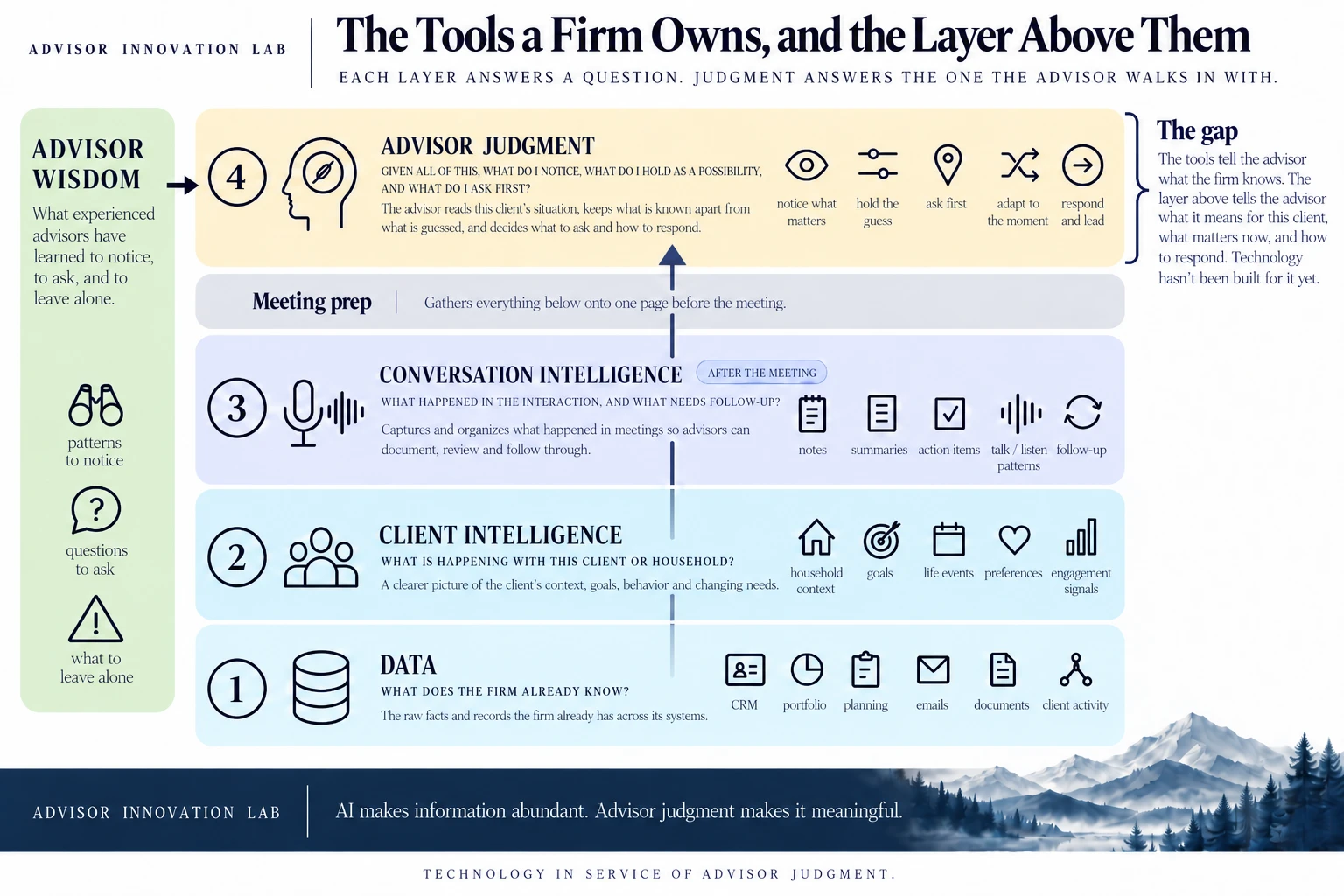
The data layer answers what the firm knows. Client intelligence pulls it together and answers what's happening with this household. Conversation intelligence, the notetaker, answers what was said last time and what needs follow-up. The newer meeting-prep tools gather all of it onto a page before the meeting. Every one of those is worth having, and I'd want them all in a firm I ran.
Judgment is the layer on top. It takes everything the others produce and answers the question the advisor walks in with, the same one from the three meetings earlier: given all of this, what do I notice, what do I hold as a possibility, and what do I ask first?
The tools you own tell the advisor what the firm knows. The layer above them tells the advisor what it means for this client, what matters now, and how to respond. That's the gap the freed time falls into, and it's the one layer technology hasn't been built for, because it had never been defined clearly enough to build for. Clients, it turns out, noticed the gap before the industry did.
What clients still come to an advisor for
HSBC asked nearly 10,000 affluent investors across ten markets this June how they use AI with their money. In the U.S., 57% use it for financial and investment tasks. Only 7% said it was the most influential factor in their last investment decision. When the decision counted, they went to a person, and HSBC's words for what they wanted from that person were "judgment, context, and conviction."
The judgment a firm is losing to retirement is the same thing its clients are paying for. Clients do the information work themselves now, and more of them arrive at the meeting with what their AI told them, wanting the advisor to say what it means for them. What they come for is a read on their own situation, from someone who has seen a hundred situations like it and can tell what's different about theirs. They come for it at the retirement, the sale, the inheritance, and the first meeting with the advisor who replaced the one they trusted. Those are the same moments a household decides whether to stay.
A client who feels understood stays, and usually brings more. A client who feels processed either quietly starts looking for another firm, or stays and moves the next dollar somewhere else. That second kind is the one the numbers hide. Schwab's RIA Benchmarking Study has reported client retention at 97% every year for a decade, across nearly 1,300 firms. The number is true, and it's why the problem is hard to see. A household can stay on the books, keep the accounts it opened fifteen years ago, and send the inheritance, the business proceeds, and the next generation somewhere else. The same study found the top-performing firms gained 3.8 times more assets from existing clients than everyone else. Everyone retained 97%. The difference was what happened in the room.
So the loss of judgment shows up on the scorecard: retention through transitions, referrals, share of wallet, whether the next generation stays. None of those lines say "judgment" on them. Which leaves the question every firm leader gets to eventually. If judgment can't be taught in a classroom, and the advisors who have it are retiring, can it be given to the ones who don't have it yet?
How a newer advisor walks in with what your best advisor knows
Partly, yes. Not the judgment itself. The preparation for it.
The industry's instinct is to go further than that. BCG's 2026 Global Wealth Report says "the judgment of the best advisors needs to be embedded in the agents being built today." The problem is the word. You can't embed what no one has written down, and thirty years of reading clients won't fit into a training module or a summary.
What a newer advisor can be given is three things, before the meeting.
First, a clear line between what's known, what's a guess, and what's unknown. The client asked about fees. The advisor who brought them in retired in the spring. Those are facts. "This may be about trust" is a guess. Whether it is, nobody knows until someone asks. Your best advisor keeps those apart in their head. A newer advisor needs them kept apart on the page. This is where the new tools go wrong. A tool reads three notes and tells a two-year advisor the client "is anxious about leaving a legacy," as if it were a fact. The advisor repeats it to the client. If the guess is right, the client feels studied. If it's wrong, the client notices, and the advisor has lost ground they didn't need to lose.
Second, what experienced advisors have learned, offered as things to consider. After a business sale, ask what life has been like since it closed before you present the allocation. When adult children sit in for the first time, ask them something directly before the parents answer for them. In the first year after a spouse dies, leave the house alone unless she brings it up. None of these are rules, because the next client won't match them. They're what your best advisors know, collected from them once, written down plainly, and handed to the advisor who needs them. The senior advisor doesn't have to give up an hour for every meeting.
Third, the decision stays with the advisor. The preparation says what to look for and what to ask. What the client says back, and what the advisor does with it, happens in the room. No tool should make that call, and a firm should be suspicious of any tool that claims to.
A newer advisor prepared this way doesn't get your best advisor's judgment. They get the same starting point: the facts, the guesses marked as guesses, the questions worth asking first. Then they make their own call, with what your best advisor would have had in front of them. That's what technology in service of advisor judgment means. It's also the only way the judgment your experienced advisors built stays in the firm after they retire.
Three questions will tell you whether your firm has this problem.
Three questions to ask your own firm
None of them needs a vendor in the room.
You've invested in freeing advisor time. What are you trying to get advisors to do differently with it?
What still takes an advisor five or ten years to learn, despite everything your training programs cover?
When a client moves from a senior advisor to a newer one, what important knowledge tends not to transfer?
The answers are usually the same thing, described three ways: the judgment of your most experienced advisors. If you want to see what it looks like when an advisor walks into a meeting with it, we've written up nine meetings, one for each of the transitions where it matters most: what a difference one meeting can make. And if you have your own answers to the three questions, I'd like to hear them.